Texas A&M

Aggies Invent

It started as a 48-hour project at Texas A&M

At Aggies Invent, a 48-hour innovation competition, the team built a binary algorithm to predict enlarged hearts from a thoracic radiograph. It won, and left a question that would not go away: if a phone can measure a heart, why is anyone still counting vertebrae with a caliper between appointments?

That prototype became RadAnalyzer, and RadAnalyzer became a partnership with the Texas A&M College of Veterinary Medicine and Sonya G. Gordon, DVM, DVSc, DACVIM. The competition algorithm answered yes or no. What shipped measures.

PLOS ONE
2026

No other veterinary app ships a published measurement algorithm

The VHS/VLAS algorithm was validated against a trained human observer and published in PLOS ONE. Below is the agreement the paper reports: how far Workup’s number sat from the observer’s, in vertebrae. The limits of agreement are the interval to carry into a borderline call — not the correlation.

VHSPearson r0.917Mean bias0.002v
1.0 v0+1.0 v

Limits of agreement -0.85 to 0.85 v

Difference from the trained observer (Workup − observer), in vertebrae. The center line is perfect agreement.

VHS: Pearson r 0.917, mean bias 0.002 vertebrae, limits of agreement -0.85 to 0.85 vertebrae against a trained human observer.

VLASPearson r0.873Mean bias0.007v
1.0 v0+1.0 v

Limits of agreement -0.44 to 0.46 v

Difference from the trained observer (Workup − observer), in vertebrae. The center line is perfect agreement.

VLAS: Pearson r 0.873, mean bias 0.007 vertebrae, limits of agreement -0.44 to 0.46 vertebrae against a trained human observer.

“Validation of deep learning enabled web based and smartphone optimized application RadAnalyzer to measure vertebral heart size and vertebral left atrial size in dogs.” PLOS ONE (2026). Authors include Sonya G. Gordon, DVM, DVSc, DACVIM, and both Workup founders. doi:10.1371/journal.pone.0337679

What the study covers

Design
Retrospective, single-center method-comparison study.
Compared to
One trained human observer. Not a panel, not board-certified radiologists, and not echocardiography — the paper names comparison against echocardiographic measures of cardiac size as future work.
Sample
1,058 client-owned dogs across 80 breeds, varied heart sizes and thoracic conformations.
Image scope
Good-quality right lateral radiographs, dogs only. The published validation does not extend to other views, other species, or poor-quality captures.
Conclusion
Differences from the human observer were of clinically insignificant magnitude, on good-quality right lateral radiographs, across dogs of all sizes.

The stack

Why we built the rest of it

A general practice day is calipers, a dosing app, two browser calculators and a reference book — each one a context switch in the middle of an appointment. Workup is the answer to that: the measurements, the doses and the lookups a small-animal or feline GP reaches for, in one app. The doses, the nine calculators and the references are on the device and hold up when the clinic Wi-Fi does not; VHS/VLAS and the USG Predictor run on cloud inference and need a connection. You do the medicine. We’ll do the math.

Who we work with

Texas A&M
The College of Veterinary Medicine, and Sonya G. Gordon, DVM, DVSc, DACVIM, who is a co-author of the PLOS ONE study behind the VHS/VLAS measurement.
Google Cloud
Google Cloud Partner. The VHS/VLAS and USG Predictor models run as cloud inference on Google Cloud; the calculators, the 326-drug catalog and the references stay on the device.

In the press

Phys.org
AI tool could help veterinarians track heart disease more preciselyTexas A&M’s write-up of the PLOS ONE study, on RadAnalyzer — the measurement that Workup ships. August 2026.
Texas A&M Engineering
Disciplines collide: Students innovate for advances in veterinary medicineAggies Invent VetMed, February 2022 — the 48-hour competition where the enlarged-heart algorithm was built and took first place. The team competed as “RadTech”, the name before RadAnalyzer; both founders are in the winners’ photo.

Two people

Who is answerable for what ships

Both are co-authors of the paper above. One is a practicing DVM who sets the clinical direction; the other builds the models.

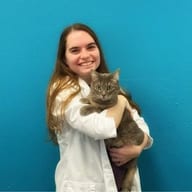
Tabitha Baibos-Reyes in a white coat, holding a grey tabby cat.

Tabitha Baibos-Reyes, DVM

Co-founder · Chief Veterinary Officer

LinkedIn

Dr. Baibos-Reyes is a feline practitioner in Houston, Texas, and the clinical mind behind Workup. She earned both her BS in Animal Science and her DVM from Texas A&M University, and practices exclusively with cats at a feline-only hospital in Houston, where her clinical interests include feline internal medicine, soft tissue surgery, and dentistry. She is currently working toward ABVP specialization in feline practice.

She is a co-author of the PLOS ONE study that underpins Workup’s cardiac measurement. As CVO she owns the app’s clinical content end to end — the drug doses, the calculators and the staging protocols are built against current evidence and revisited as guidelines change. Her standard for the app is the one she holds in her own exam room: if you cannot rely on it mid-appointment, it is not ready.

She is a member of the Texas Veterinary Medical Association and the Feline Veterinary Medical Association. She grew up in Katy, Texas, and lives in Houston with her husband, son, four cats, and two dogs.
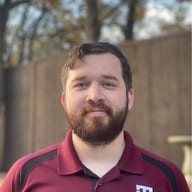
Tomas Reyes outdoors, wearing a maroon Texas A&M polo shirt.

Tomas Reyes

Co-founder · CEO

LinkedIn

Tomas Reyes is an engineer in Houston, Texas, and the technical half of Workup. He earned both his BS and MS in Electrical Engineering from Texas A&M University, and started RadAnalyzer while still in school, after the first version of the enlarged-heart algorithm was built at Aggies Invent. He builds the models, the inference backend, and the iOS and Android apps.

He is a co-author of the PLOS ONE study that underpins Workup’s cardiac measurement. He owns the technical side of every algorithm that ships — training and validating the models, the quality tiers that flag a low-confidence result, and the per-input explainability behind the feline USG Predictor. His standard is that a veterinarian should never have to take a number on faith: every scan carries a quality tier of OPTIMAL, GOOD or REVIEW, and a measured VHS is shown against a published normal range — the breed’s own where it is one of the 20 with published ranges, and a general canine range otherwise.

He is a member of the IEEE. He grew up in Dallas, Texas, and lives in Houston with Tabitha, their son, four cats, and two dogs.

What we will not claim

Workup is decision support for licensed veterinary professionals. It is not FDA- or USDA-cleared as a medical device, and it is not a substitute for your judgment or for specialist interpretation. The feline USG Predictor is a pilot — a screening prompt to flag cats that need urinalysis, not a replacement for one. Apply to the pilot.

We also do not do documentation. No scribe, no consult notes, no records, no literature search — that is a choice about what this product is for, not a gap we are working on.

Try it

Run it on your next right lateral

Workup runs on iOS and Android, with a 30-day free trial on every plan.